What Would Make Today 1% More Supportive?
- Integrated Wellbeing Consulting

- Aug 15
- 7 min read
Why meaningful wellbeing may have less to do with overhauling your life and more to do with making the life you already have a little easier to live
When life feels difficult, many of us instinctively start looking for a solution. Not just any solution, either. We often look for the big solution.
We decide we need a completely new routine. A better schedule. A different system. More discipline. More motivation. A fresh start.
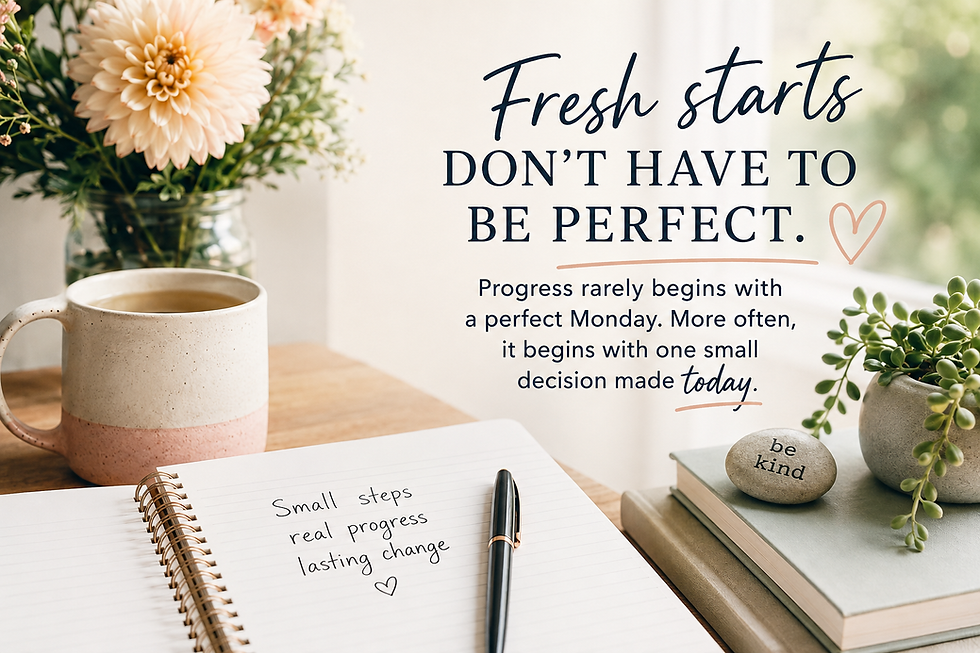
Maybe Monday will be different.
Maybe next month will be different.
Maybe once we finally get organized, catch up on sleep, start exercising consistently, plan our meals, answer the emails, clean the house, manage our stress, and get everything else under control, then we will feel better.
There is just one problem. When we're already managing significant stress or competing demands, attempting a major life overhaul can add another layer of effort and expectation at a time when our cognitive and emotional resources may already feel stretched.
Research supports the idea that stress can affect processes involved in everyday functioning, including working memory, cognitive flexibility, attention, and decision making, although these effects are complex and can vary depending on the person, situation, type of stressor, and task.
So perhaps there is another question worth asking:
What would make today feel 1% more supportive?
Not completely better.
Not fixed.
Not perfect.
Just a little more manageable.
When Wellbeing Becomes Another Job
There is no shortage of messages telling us how we could be doing wellbeing better. Wake up earlier. Develop a morning routine. Meal prep. Exercise. Meditate. Journal. Reduce screen time. Drink more water. Practice gratitude. Organize your home. Improve your sleep.
None of these things are inherently bad. Many can be genuinely supportive. But taken together, wellbeing can quietly become another performance standard.
Instead of asking, "What do I need?" we start asking, "What should I be doing?"
That distinction matters.
A person navigating grief may not need the same routine as someone entering an exciting new season of life. Someone experiencing burnout may not benefit from adding five new habits to an already overflowing schedule. A person in recovery may have very different needs from one day to another. Someone caring for children, aging parents, employees, students, clients, or a loved one may have very little discretionary time left at the end of the day.
Context matters.
Capacity matters.
And sometimes the most supportive choice available to us is not the choice that looks the most impressive from the outside.
Why 1%?
One percent is intentionally small, though we recognize there are times that even 1% can feel large. There is nothing scientifically magical about the number itself, nor is 1% a clinical threshold or prescribed intervention. It is simply a way of shifting the question away from "How do I make everything better?" and toward "What might help a little?"
When we expect ourselves to completely transform a difficult situation, the distance between where we are and where we think we should be can feel enormous.
A smaller question gives us somewhere else to start.
What could reduce one point of friction?
What could make the next hour easier?
What could provide a little more comfort?
What could conserve some energy?
What could help me feel slightly more connected, nourished, rested, supported, or grounded?
The answer may be remarkably ordinary. And that is exactly the point.
Support Doesn't Always Look Like Doing More
Maybe 1% more supportive looks like eating something before you become overly hungry. Maybe it means stepping outside for five minutes because you've been staring at a screen for hours. Maybe it means ordering dinner instead of cooking. Maybe it means asking someone for help. Maybe it means putting your phone somewhere else while you drink your morning coffee. Maybe it means cancelling something that doesn't actually need to happen. Maybe it means making the appointment you've been avoiding. Maybe it means listening to music on your drive home instead of filling every quiet moment with another podcast, phone call, or task.
Maybe it means wearing the comfortable clothes. Taking the shortcut. Using the paper plates. Closing the laptop. Sitting down. Going to bed even though everything isn't finished.
Sometimes support is adding something. Sometimes it is removing something. Sometimes it is changing an expectation. And sometimes it is allowing yourself to enjoy something without needing to make it productive, educational, healthy, efficient, or useful.
Small Does Not Mean Insignificant
We tend to notice dramatic change. The transformation. The breakthrough. The before and after. But much of everyday wellbeing is considerably less dramatic.
In everyday life, wellbeing often has less to do with one dramatic transformation and more to do with the ways we respond to our needs across ordinary moments.
During periods of stress, transition, grief, recovery, burnout, uncertainty, caregiving, or simply being a human with a lot going on, smaller actions may feel more accessible than ambitious changes.
They can also give us an opportunity to practice something important: responding to ourselves rather than constantly managing ourselves.
Instead of automatically asking what we need to improve, we can become curious about what we are experiencing.
I'm exhausted. What would support me?
I'm overwhelmed. What could make this easier?
I'm lonely. Is there a form of connection that feels accessible today?
Everything feels like too much. What can wait?
I don't have much capacity today. What actually needs my energy?
That is a very different relationship with wellbeing. It is less about controlling ourselves and more about noticing ourselves.
There is also evidence that approaches emphasizing self-compassion can support psychological wellbeing. A meta-analysis of randomized controlled trials found that self-compassion focused interventions were associated with reductions in stress, anxiety, and depressive symptoms, although the researchers also identified important limitations in the quality of the available evidence.
Compassion does not require us to pretend difficult things aren't difficult. It can simply change how we respond to ourselves while they are difficult.
Support Can Be Flexible
What makes today 1% easier may not be what makes tomorrow 1% easier.
That's okay.
Human beings aren't static, and wellbeing doesn't need to be either. One day you may need movement. Another day you may need rest. One day connection may feel restorative. Another day you may desperately need quiet.
Sometimes structure is supportive. Sometimes loosening the schedule is. Sometimes cooking a meal feels grounding and enjoyable. Sometimes heating something frozen is exactly the support you need.
A person-centered approach to wellbeing leaves room for those differences. Rather than assuming there is one universally "healthy" response, we can ask what is supportive for this person, in this context, with this capacity, on this particular day.
That includes ourselves.
The One Thing Check In
If you're not sure where to begin, try a brief check in. You don't need a journal, worksheet, app, or perfectly quiet environment. You can do this while drinking your coffee, sitting in your car, walking between meetings, or getting ready for bed.
1. What feels heaviest right now?
Don't immediately try to solve it.
Just identify it.
Maybe it is work. A relationship. Money. Grief. Your health. Your schedule. A decision. Something happening in your family.
Or maybe you can't identify one specific thing and simply know that everything feels heavy.
That counts, too.
2. What could I use more of right now?
Try to think beyond what you believe you should need.
Maybe you need rest.
Connection.
Food.
Movement.
Quiet.
Support.
Fun.
Structure.
Space.
Comfort.
Predictability.
Creativity.
Reassurance.
Help.
Or something completely different.
3. What is one realistic thing that might make today 1% easier?
The word realistic matters.
The question isn't what would help if you had unlimited time, energy, money, support, or resources.
It is:
Given the life I am actually living today, what is one thing available to me that might make this a little more supportive?
Maybe there is something you can do.
Maybe there is something you can stop doing.
Maybe there is something you can postpone.
Maybe there is someone you can ask.
Maybe there is an expectation you can loosen.
And maybe today, simply recognizing that you are carrying a lot is the 1%.
Small Support Is Not a Solution to a Systemic Problem
There is an important distinction here. There will be times when bigger changes are necessary. A five minute break cannot solve chronic workplace problems. A cup of tea cannot eliminate financial stress. A walk cannot resolve grief. A breathing exercise cannot make an unsafe environment safe. And individual wellbeing practices cannot substitute for adequate healthcare, supportive relationships, accessible resources, safe environments, appropriate professional care, or systems that meet people's needs.
We should be careful not to use individual wellbeing strategies to minimize very real circumstances or place responsibility for systemic problems entirely on the person experiencing them. But small support does not have to solve the whole problem to matter. We can acknowledge the bigger problem and look for ways to care for ourselves while we move through it.
Both can be true.
You can want something in your life to change and still make today a little gentler.
You can work toward larger goals and still take the shortcut tonight.
You can be building something new and still need rest.
You can be struggling and still experience moments of joy.
You can have a lot left to figure out and still support yourself along the way.
You Are Allowed to Start Small
There is a tendency to think that if something isn't transformative, it isn't meaningful. But support doesn't always need to transform us. Sometimes it simply needs to support us. Maybe today isn't the day you develop the perfect routine. Maybe today is the day you eat lunch. Maybe you don't solve the entire problem. Maybe you send the email asking for help. Maybe you don't reorganize your life. Maybe you clear one thing from your calendar. Maybe you don't become a different version of yourself. Maybe you simply respond to the version of yourself who is here today with a little more curiosity, flexibility, and compassion.
Wellbeing doesn't have to begin with changing your entire life. Sometimes it begins by looking at the life you're already living and asking:
What would make today 1% more supportive?
And then giving yourself permission to let a small answer be enough for today.
References
Research examining stress and cognition suggests that acute and chronic stress can influence executive functions and decision making, although effects vary based on the nature of the stressor, the task, timing, and individual and contextual factors.
Research on self compassion interventions also suggests potential benefits for stress, anxiety, and depressive symptoms, while highlighting limitations in the current evidence base and the need for additional high quality research.


Comments