Why Fresh Starts Don't Have to Be Perfect

By Katherine Melton, BSE, MPH, MCHES, CWP
There is something about August that feels like a fresh chapter.
Perhaps it is the return of school buses, the new planners appearing on desks, or the subtle shift that comes as summer begins to wind down. Even for those who have not stepped into a classroom in years, August often carries a feeling of beginning again. Routines change. Calendars fill. Many of us naturally start thinking about the months ahead.
Psychologists have found that certain points in time, such as the beginning of a week, a new month, a birthday, or the start of a school year, can act as temporal landmarks. These moments create a psychological sense of separation between our past and future selves, making change feel more attainable. Researchers refer to this as the Fresh Start Effect, and it helps explain why so many people feel motivated to set new goals during seasons of transition.
Fresh starts can be powerful.
They can also become overwhelming when we believe they require us to change everything all at once.
The Pressure to Get It Right
August often arrives with a long list of expectations.
Get organized.
Meal prep every week.
Wake up earlier.
Exercise consistently.
Keep the house cleaner.
Finally become the version of yourself you have been hoping to become.
Goals can certainly be meaningful. The challenge comes when we quietly attach perfection to them. We convince ourselves that this time we will follow the plan flawlessly.
Then life does what life inevitably does.
A meeting runs late.
A child gets sick.
Energy is lower than expected.
Plans change.
One missed workout becomes, "I have failed."
One busy week becomes, "I will start again next Monday."
The problem is rarely the missed day itself. The problem is believing that one imperfect day erased all of the progress that came before it.
The Trap of All or Nothing Thinking
Psychologists often describe this pattern as all or nothing thinking, sometimes called black and white thinking. It is a common cognitive distortion in which experiences are viewed in extremes rather than along a continuum.
It sounds like this.
"If I cannot do the full workout, there is no point."
"I already ate something I did not plan for, so today is ruined."
"I missed one day, so I have failed."
"I will just start over on Monday."
Real life rarely fits neatly into categories of success or failure.
Instead, it unfolds somewhere in between.
Building new habits means adjusting when circumstances change, making room for flexibility, and continuing forward after setbacks. Flexibility is not evidence that you have failed. More often, it is one of the very skills that allows meaningful change to last.
Consistency Matters More Than Intensity
A common misconception about behavior change is that it requires dramatic action.
Behavioral science suggests something different.
Habits become more automatic through repeated behaviors performed in consistent contexts. Motivation can certainly help us begin, but motivation naturally rises and falls over time. Lasting habits are more likely to develop when our behaviors fit into our daily lives and are supported by routines and environmental cues.
Larger behavior changes often require more planning, decision making, and self regulation. During periods of stress or transition, those mental resources may already be stretched.
That is one reason smaller, more realistic changes are often more sustainable over time, particularly during seasons that already demand a great deal from us.
Instead of asking,
"How can I completely transform my routine?"
Consider asking,
"What is one action I could realistically repeat, even on a difficult day?"
That action might be as simple as:
Drinking one extra glass of water.
Taking a five minute walk.
Stretching while your coffee brews.
Packing tomorrow's lunch before bed.
Stepping outside for a few minutes of fresh air.
Practicing one minute of slow, intentional breathing.
Individually, these actions may not feel remarkable. They probably will not create dramatic change overnight. Yet repeated over time, they begin to shape routines that fit naturally into everyday life. Because they remain realistic, even on difficult days, they are often more likely to last.
Your Brain Learns Through Repetition
One of the remarkable qualities of the human brain is its ability to adapt throughout life, a capacity known as neuroplasticity.
When we repeatedly practice a behavior, the brain gradually becomes more efficient at performing it. Over time, actions that once required significant attention can begin to feel increasingly automatic.
Imagine walking across a grassy field.
The first trip requires choosing a path.
Walk the same route often enough, and a trail begins to appear.
Habits develop in much the same way. The goal is not to walk perfectly every single time. The goal is simply to keep returning to the path often enough that it becomes easier to follow.
Self-Compassion Is Part of the Process
Many people worry that being kind to themselves will lower their standards or reduce accountability.
Research suggests the opposite.
Self-compassion has been associated with greater emotional resilience, healthier coping strategies, and, in many studies, greater persistence after setbacks. When people respond to mistakes with understanding rather than harsh self-criticism, they are often better able to learn from the experience and reengage with their goals.
Imagine speaking to yourself the way you would speak to someone you deeply care about.
If that person missed a workout, had a stressful week, or struggled to keep up with a new routine, you probably would not tell them they had ruined everything.
You would remind them that tomorrow offers another opportunity.
You deserve that same compassion.
A Different Kind of Fresh Start
As August unfolds, perhaps the invitation is not to become an entirely different person.
Perhaps it is simply to become a little more intentional with the life you are already living.
Rather than chasing the perfect routine, choose one that fits your real life.
Rather than waiting until everything is in place, begin with what feels possible today.
Rather than measuring success by perfection, consider measuring it by consistency, flexibility, and the willingness to begin again.
Meaningful change rarely happens all at once.
It grows through ordinary moments that are repeated with patience, curiosity, and care.
Progress is not built by never getting off course.
It is built by returning, again and again, with kindness toward yourself.
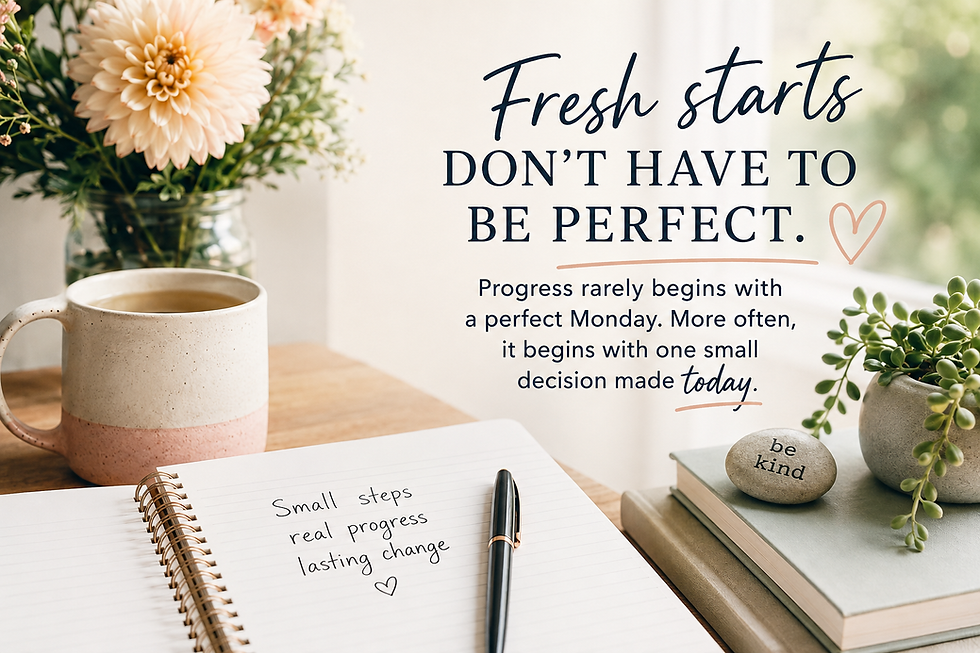
Progress rarely begins with a perfect Monday. More often, it begins with one small decision made today.


Comments